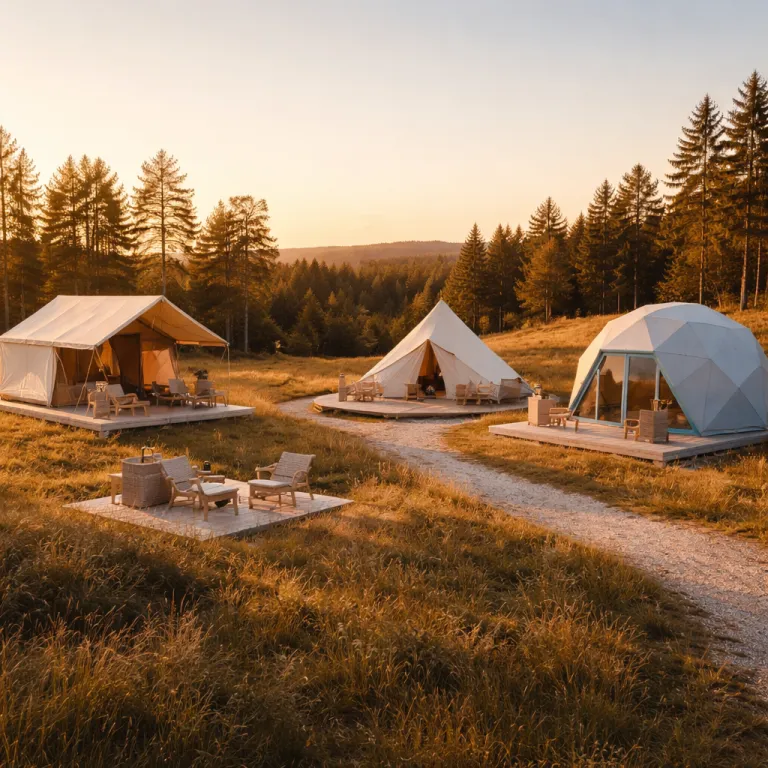
Why the structure matters more than the amenity list
Choosing between the main types of glamping tents shapes your entire stay. The same landscape feels radically different from a low bell tent, a raised safari tent, or a mirrored dome tent with a panoramic view. When you book any luxury glamping tent, you are really choosing how you want to hear the night, frame the horizon, and balance comfort with the rawness of camping.
Glamping has grown from a niche idea to a global market worth several billion dollars, driven by travelers who want outdoor immersion without sacrificing a proper bed, a private bathroom, and curated interior design. According to Statista’s 2023 overview of the global glamping sector, the market was valued at around 2.1 billion USD in 2022, with steady expansion across North America and Europe. Grand View Research’s 2022 glamping report notes that cabins and pods still hold the largest share, yet tent based accommodations are the fastest growing segment for guests who value experience over square metres of masonry. As one expert summary puts it, “Glamping is luxury camping with modern amenities.”
For couples planning a romantic escape, the popular types of tents glamping now range from intimate bell tents to multi room safari tents and futuristic dome tents with glass fronts. Each tent structure has its own capacity limits, climate strengths, and privacy profile, which matter more than whether the minibar is complimentary. Understanding these key features lets you read between the lines of glossy listings and select the best glamping option for your style of travel.
Safari tents and safari lodges: canvas suites for serious comfort
Safari tents are the grand dames of glamping tents, the format perfected on African reserves and now exported to the American West and parts of Asia. A classic safari tent or lodge tent usually sits on a raised wooden deck, with canvas walls, a peaked roof, and a shaded veranda that becomes your outdoor living room. Inside, you can expect a real bed, generous capacity for luggage, and often a partitioned interior that separates sleeping, lounging, and bathroom zones.
At high end camps such as &Beyond Ngala Safari Lodge or Singita Sabora in Tanzania, each safari tent functions more like a canvas suite than a simple camping shelter. These safari tents typically include a private bathroom with hot water, double vanities, and sometimes a freestanding tub facing the plains, which transforms the nightly routine into a theatre of wildlife and sky. Many safari lodge operators also install wood burning stoves or efficient space heaters for cooler nights, allowing near year round operation even when temperatures drop sharply after sunset.
Safari tents excel in dry climates with predictable wind patterns, which is why you see them across the Serengeti, the Maasai Mara, and the high desert of Utah. Typical floor areas range from about 25 to 60 square metres, with capacity for two to six guests depending on layout. In very high wind coastal locations, the tall walls and broad roof of a safari tent can catch gusts like a sail, so the best glamping sites there often favour lower dome tents or more aerodynamic lodge tents. If you want to go deeper into the safari tent experience, look for independent guides that explain how top tier camps design their canvas accommodations for both safety and romance, including anchoring systems, fire safety standards, and recommended wind ratings.
Bell tents: romantic canvas circles for short, stylish stays
Bell tents are the entry point for many people into tent glamping, and they remain one of the most popular types of glamping tents for couples. A bell tent is defined by its single central pole, circular footprint, and sloping canvas walls that create a cosy, lantern like interior when lit at night. Because the walls angle inwards, the usable capacity feels intimate rather than expansive, which suits weekend escapes more than extended stays.
In well run glamping sites, you will find bell tents dressed with layered rugs, low level lighting, and often a wood burning stove near the centre pole, which turns a simple camping tent into a snug retreat. A typical 4–5 metre bell tent comfortably sleeps two adults, with some larger 6 metre versions accommodating small families on additional beds or futons. Some operators pair each bell tent with a separate private bathroom hut a few metres away, while others keep shared facilities to maintain a lighter footprint on the landscape. For couples, this layout can feel charming and authentic, but for families with young children, the night time walk to the bathroom in bad weather may quickly erode the sense of luxury.
Bell tents shine in sheltered meadows, forest clearings, and festival style fields where the focus is on atmosphere rather than strict year round operation. When you compare bell tents with safari tents, think of the former as candlelit studios and the latter as one bedroom apartments, both still firmly in the world of tents glamping. As a rule of thumb, bell tents offer excellent ventilation but limited insulation, so they are best for late spring to early autumn. If you are booking a bell style glamping tent, check the stated capacity carefully, ask whether the stove is genuinely wood burning or decorative, and confirm how far your private bathroom or shared block sits from the canvas door.
Domes and dome glamping: panoramic views with a modern edge
Geodesic domes have become the visual shorthand for modern glamping, especially in mountain and polar landscapes where weather resilience matters. A dome tent uses a network of intersecting poles to create a semi spherical frame, which spreads wind and snow loads more evenly than traditional tents. This engineering allows many dome tents to operate year round in exposed locations where a tall safari tent or bell tent might struggle.
Most glamping dome structures feature a large transparent panel facing the view, turning the entire front of the glamping tent into a picture window for sunrise and stars. Inside, the absence of internal poles creates flexible capacity for king beds, lounge areas, and sometimes a compact bathroom pod, though not every dome tent includes a fully plumbed private bathroom. Standard dome diameters range from about 5 to 8 metres, giving floor areas of roughly 20 to 50 square metres and capacity for two to four guests. The aesthetic is unapologetically modern, which appeals to design conscious travelers but can feel less like classic camping for purists who crave the texture and scent of traditional canvas.
Dome glamping works particularly well in alpine valleys, Arctic circles, and desert plateaus where the sky show is the main event and insulation is critical. Many commercial dome systems are rated for strong winds and moderate snow loads when correctly installed, but performance depends heavily on anchoring and local building codes. If you are comparing dome tents with other popular types of glamping tents, pay attention to ventilation systems, shading for the clear panels, and whether a wood burning stove, heat pump, or underfloor heating is provided for shoulder seasons. For a deeper dive into how dome structures are being reimagined for luxury, seek out neutral resources that unpack the key features of umbrella dome houses and other next generation dome accommodations rather than relying on a single promotional source.
Lodge tents and hybrid structures: flexible spaces for couples and families
Lodge tents sit between safari tents and cabins, borrowing the pitched roof and timber framing of a small lodge while retaining canvas walls and the soul of camping. A typical lodge tent uses a rigid frame with straight walls, which immediately increases interior volume and makes it easier to create separate bedrooms for families. Many lodge tents also integrate a covered terrace, giving you an outdoor dining area that remains usable in light rain and cooler evenings.
For couples, a smaller lodge tent can feel like a private pavilion, with a king bed, a seating area, and an en suite private bathroom tucked behind a solid or semi solid partition. Larger lodge tents, sometimes marketed as safari lodge suites, can host families or small groups with two or three sleeping zones, each still under canvas but with enough separation for privacy. Typical footprints range from about 30 to 70 square metres, with capacity for four to eight guests when bunk beds or sofa beds are included. Because of their structural stability, lodge tents are often certified for year round use in temperate climates, especially when fitted with efficient wood burning heaters, insulated flooring, and double layered canvas or fabric liners.
Hybrid designs are emerging too, blending lodge tents with dome tents or tree platforms to create unique accommodations that respond to specific landscapes. You might see a lodge tent perched on a raised deck among tree canopies, or a row of lodge tents paired with smaller bell tents to give teenagers their own space while staying close to parents. When browsing tent glamping listings, look for clear floor plans, stated capacity, and honest photography that shows how much of the structure is solid versus canvas, as this will shape both the acoustic experience and the feeling of connection to the outdoor environment.
Tree based tents and elevated platforms: height, privacy, and a different soundscape
Tree based tents and elevated platforms change not just your view but the way you hear the landscape. Suspended tree tents, canvas cabins on stilts, and raised safari tents all fall into this family of glamping tents that prioritise height and seclusion. For couples, the appeal is obvious, as climbing a short staircase to a tent in the trees feels inherently romantic and slightly adventurous.
From a design perspective, tree focused accommodations must balance weight, wind, and root protection, which is why many operators choose lighter tent structures rather than full cabins. A tree level glamping tent might be a compact dome tent with a wraparound deck, a bell tent on a timber platform, or a small lodge tent with a steep staircase and a discreet private bathroom tucked beneath. The capacity of these tents is usually limited to two or three guests, making them less suitable for larger families but ideal for couples who value privacy over floor space.
Because elevated tents are more exposed, insulation, anchoring, and safe access become key features to scrutinise before booking. In many regions, platforms must comply with local safety codes for railings and staircases, and some sites close during the stormiest months to reduce risk. If you plan to travel outside peak summer, ask whether the tent includes a wood burning stove, how the bathroom is heated, and whether the site operates year round or shuts seasonally. For many travelers, the trade off is worthwhile, as waking to birdsong at eye level with the canopy delivers an experience that no ground based camping tent or standard hotel room can replicate.
How to match tent type to your trip and travel style
Once you understand the main types of glamping tents, matching them to your trip becomes a strategic choice rather than a guess. For a romantic weekend, a well appointed bell tent or compact safari tent with a private bathroom and a small wood burning stove often feels perfectly scaled. If you are planning a longer stay or travelling with children, a larger safari lodge or lodge tent with separate sleeping areas, generous interior storage, and better insulation will usually deliver more comfort.
Climate should be your next filter, because not every tent glamping structure performs equally in every season. Dome tents and glamping dome suites tend to handle wind and snow better, which makes them strong candidates for year round mountain or coastal stays, while classic safari tents and bell tents shine in dry, mild conditions where ventilation matters more than insulation. When reading listings, look beyond the word luxury and focus on tangible key features such as heating type, bathroom layout, deck size, and stated capacity, all of which directly affect your daily experience.
Finally, consider how much you want to feel the outdoor environment versus how much you prioritise acoustic privacy and hotel like amenities. Canvas rich safari tents and bell tents keep you closer to the sounds of the night, while more solid lodge tents and domes mute the elements but can feel slightly less wild. Whatever you choose, remember that glamping exists to “experience nature without sacrificing comfort” and to “provide unique accommodations” that sit between traditional camping and conventional hotels, so let those principles guide your selection.
Key figures shaping the luxury glamping tent landscape
- The global glamping market is valued at around 2.1 billion USD according to Statista’s 2023 market size estimate for 2022, reflecting how quickly travelers are shifting from standard camping to higher comfort tents and hybrid accommodations.
- Grand View Research’s 2022 glamping industry report cites an annual growth rate of approximately 12.5 percent for the sector, indicating that new safari tents, dome tents, and lodge tents are entering the market every year to meet rising demand.
- Industry analyses summarised in the same reports show that while cabins and pods hold roughly 45 percent of the glamping segment, tent based structures are the fastest growing category for experiential travelers seeking closer outdoor immersion.
- Many premium safari lodge operators now design their safari tents and lodge tents for near year round use, adding insulation, double roofing, and wood burning or gas heating to extend their operating season beyond traditional dry months.
- Families represent a growing share of glamping guests, encouraging sites to increase the capacity of safari tents and lodge tents and to add more multi room layouts with en suite bathrooms, blackout curtains, and weather rated decks.
FAQ about luxury glamping tents and structures
What is glamping and how is it different from camping ?
Glamping is luxury camping with modern amenities, which means you sleep in tents or similar structures but enjoy real beds, styled interiors, and often a private bathroom. Traditional camping usually involves pitching your own tent and sharing basic facilities. Glamping sites use pre erected tents, curated furnishings, and on site services to create a more comfortable and often more design led experience.
What types of tents are most common in glamping sites ?
The most common types of glamping tents are safari tents, bell tents, geodesic dome tents, and lodge tents, each offering a different balance of space and atmosphere. Some sites also use tree based tents or hybrid structures that combine timber frames with canvas walls. When browsing options, focus on how each tent type handles climate, privacy, and capacity for your group.
Is glamping suitable for families with children ?
Glamping is suitable for families, especially when you choose safari tents or lodge tents with multiple sleeping areas and an en suite bathroom. Many sites design their accommodations and activities specifically for families, offering safe outdoor spaces and child friendly services. Bell tents and compact domes can work for short stays, but larger structures usually provide more comfort for longer holidays.
How should I prepare for a stay in a luxury glamping tent ?
Before your trip, research site amenities carefully, check local weather conditions, and pack layers suitable for cooler nights under canvas. Even with luxury interiors, tents respond more directly to temperature changes than solid buildings, so good clothing makes a difference. It is also wise to confirm whether your tent includes heating, a private bathroom, and year round access to on site facilities.
Are eco friendly options available among luxury glamping tents ?
Many luxury glamping operators now prioritise eco friendly accommodations, using sustainably sourced timber, low impact platforms, and energy efficient heating for their tents. Safari tents, dome tents, and lodge tents can all be designed with minimal ground disturbance and careful water management. When booking, look for clear information on environmental practices rather than relying solely on green marketing language.